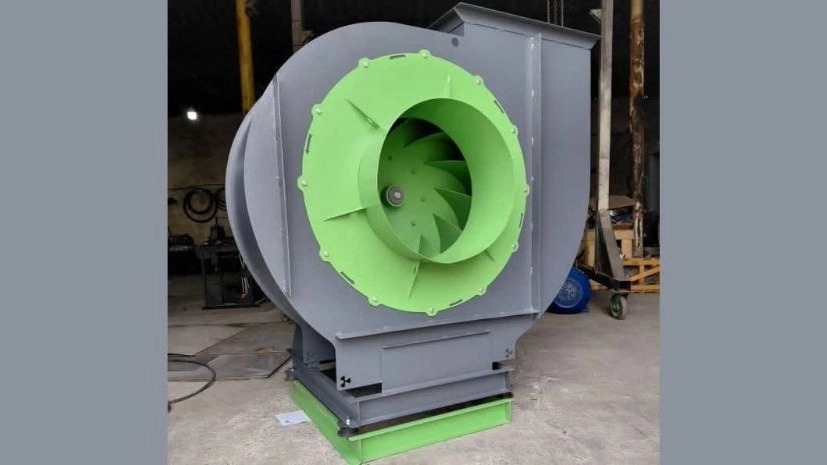
Air conditioning and air circulation in industrial spaces is one of the main pillars of maintaining the health of employees, increasing the life of machinery and improving the efficiency of production processes. Among the types of aeration equipment, the backward centrifuge is known as one of the most efficient and popular air transfer systems. By using advanced engineering design and backward bent propellers, these equipments have been able to create a great transformation in optimizing energy consumption and increasing the efficiency of ventilation systems.
In this specialized article, we will carefully examine the structure, performance, advantages and various applications of backward centrifuge and we will examine the key role of Nasim Fan as one of the pioneers in the production of these products in the country.
Part I: What is a backward centrifuge and how does it work?
To better understand the operation of the backward centrifuge, we must first familiarize ourselves with the basic structure of centrifugal fans. These equipments, which are also called radial or centrifugal fans in scientific terms, circulate air or gas in the direction perpendicular to the inlet axis.
Propeller design and air movement mechanics
The distinguishing point in the Backward centrifuge is its appearance and the angle of its impeller blades. In this type of fan, the blades are bent in the direction opposite to the rotation of the propeller. This special design allows the air flow to reach the right speed and pressure when it hits the blades and is discharged from the outlet opening with the least amount of turbulence.
This type of mechanical design has several important structural features:
Second part: technical features and advantages of the backward centrifugal fan
Designing and manufacturing industrial ventilation equipment requires knowledge of metallurgy, fluid dynamics and accurate electromechanical calculations. Relying on years of practical experience and using advanced simulation software, Nasim Fan launches products that pass strict industry standards.
In the following, we examine the most important technical features of the backward centrifuge designed by this collection:
1. Optimizing energy consumption and high efficiency
Energy crisis and high electricity costs in industrial units have doubled the importance of using low consumption equipment. Backward Centrifuge produced in the Nasim Fan series offers the highest energy efficiency (sometimes up to more than 85% of mechanical efficiency) due to the precise aerodynamic design of the propellers. In the long run, this will greatly reduce the current costs of factories.
2. Low depreciation and long life
3. Body resistance in harsh environmental conditions
Industrial equipment is often exposed to humidity, corrosive gases, suspended particles and high temperature. The body and propellers made in the specialized workshops of Nasim Fan are made of thick sheets of steel, galvanized or stainless steel (according to the client's order). Also, the use of furnace electrostatic paint coatings guarantees the resistance of this equipment against corrosion and rust.
The third part: wide applications of backward centrifuge in different industries
The ability to produce the right aeration pressure and volume makes the Backward Centrifuge a versatile tool in ventilation projects. In the following, we mention some of the most important platforms for the use of this equipment:
1. Air conditioning systems and large air conditioners
In large commercial buildings, hospitals and office complexes, air handling units (AHU) are responsible for supplying fresh air. Due to the pressure drop caused by the air passing through the cooling/heating coils and multi-stage filters, the use of backward centrifuge is the best option for placing in the structure of air conditioners due to the provision of high static pressure and low noise operation.
2. Filtration and industrial dust collectors (bag filters)
In cement, tile and ceramic factories, wood and mining industries, industrial dust collectors play a vital role in cleaning the air in the workshop. Suctioning contaminated air mixed with fine particles through the filter bags requires a strong suction. Backward Centrifuge manufactured by Breeze Fan easily overcomes the resistance of bag filters and returns clean air to the environment.
3. Chemical and pharmaceutical industries
In environments dealing with acid gases, solvents, or volatile chemicals, rapid evacuation of these gases is critical to personnel safety. Ventilation systems designed by Nasim Fan with anti-acid material and explosion-proof electromotors provide full security of the gas discharge process in these industries.
4. Industrial kitchens and restaurants
Industrial hoods installed in large kitchens absorb a large amount of fat, heat and smoke. To transfer this heavy and greasy air from the path of long ducts to the roof, a powerful fan with easy cleaning capability is needed. Due to the greater distance between the blades, backward propellers are less prone to accumulation of grease and soot and maintain their efficiency.
Part 4: Key criteria in the selection and design of a backward centrifuge
Purchasing an industrial ventilation system without performing accurate engineering calculations can lead to a loss of capital or system inefficiency. Specialist engineers at Nasim Fan always recommend that the following parameters be carefully evaluated before ordering and manufacturing the device:
1. Flow rate or aeration volume (CFM / M3/h)
This factor determines how much air the fan moves per hour. Calculation of air flow depends on the dimensions of the hall, the number of air changes required per hour and the type of use of the space.
2. System static pressure drop (Static Pressure)
The resistance of the entire ducting path, elbows, dampers, filters and hoods should be calculated in millimeters of water or pascals. Backward centrifuge must be designed in such a way that it can overcome this pressure drop.
3. Working temperature and fluid characteristics
If the flow of passing air has high heat (such as furnaces or drying systems), the material of the impeller and the shaft of the device must be changed. Also, the presence of suspended particles, high humidity or corrosive gases directly affects the selection of the type of sheet and electric motor.
4. Power transmission type (direct connection or poly belt)
Connecting the electric motor to the propeller can be done as a direct coupling (Direct Drive) or through a belt and pulley (Belt Drive). Direct systems have lower maintenance costs, while belt systems offer more flexibility in fan speed regulation.
Part 5: Why choose the Nasim Fan brand?
The market of industrial ventilation equipment offers many options to buyers, but the commitment to quality and after-sales service differentiates brands from each other. Nasim Fan company offers many competitive advantages to its customers by focusing on customer satisfaction and complying with world standards:
- Custom design based on the project: Every industrial project has its own characteristics. Nasim Fan is able to customize the dimensions, the angle of the propellers and the power of the device exactly according to the computing needs of your project.
- Use of high-quality materials: The use of standard steel sheets with engineered thicknesses, machined steel shafts and reliable internal and external electric motors are the basic principles of production in this series.
- Accuracy in dynamic balance: The smallest Vibration at high speeds leads to the destruction of bearings and damage to the fan body. The quality control unit of Nasim Fan, using modern computerized balance equipment, guarantees the silent and vibration-free operation of the device.
- Continuous technical support: The company of experienced experts from the initial consultation and design stage to installation, commissioning and after-sales service brings peace of mind to project managers.
The sixth part: important points in maintenance and periodical service of industrial fans
To ensure continuous and uninterrupted operation of backward centrifuge in production lines, it is necessary to implement a regular program for the care and maintenance of the equipment:
- Lubrication and greasing of bearings: Bearings and bearings should be lubricated at specific intervals with appropriate grease to prevent heating and wear of parts.
- Checking belt tension: In belt drive models, loosening or excessive tightness of belts can damage the shaft and motor or reduce the efficiency of ventilation.
- Vibration and sound monitoring: Any unusual sound or change in the machine's vibration pattern should be investigated immediately; Because it may be a sign that the propeller is unbalanced due to the accumulation of mass or physical damage.
- Propeller cleaning: The accumulation of dust or grease on the blades of the backward centrifuge disrupts its dynamic balance. Periodic cleaning of propellers helps to maintain the efficiency of the device.
Summary and conclusion
Industrial air conditioning systems are the vital arteries of factories and large workspaces. Choosing a backward centrifuge with engineering design, high energy efficiency, strong body and optimal operation, not only ensures the health of the working environment, but also significantly reduces the maintenance costs and electricity consumption of industries.
The specialized company Nasim Fan, relying on the knowledge of domestic engineers, modern machinery and commitment to quality standards, stands as a reliable partner in the design, manufacture and supply of all kinds of industrial centrifugal fans alongside the civil and industrial projects of the country to bring the best efficiency and durability to your air conditioning systems.